On Your Feet!
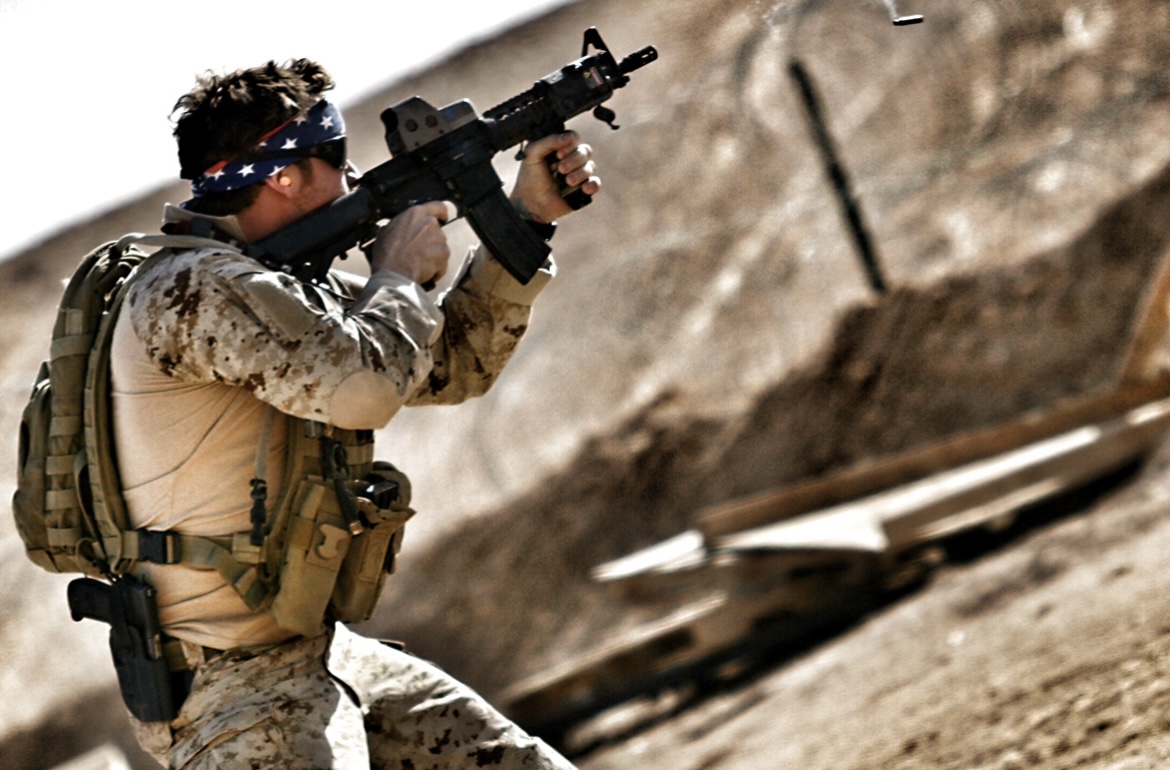
Boise, Idaho. – Travis Fishburn, 38, is never out of the fight. As a Navy SEAL for nine years, if he got knocked down, he got back up – every time.
Today, you still can’t catch him off his feet for long. …..
His career getting knocked down started in Basic Underwater Demolition/SEAL (BUD/S) training and Hell Week in his early twenties. At the Naval Amphibious Base in Coronado, California, potential SEALs spend weeks tired, uncomfortable and hungry. Their mental and physical strength is pushed to the limits. Hell Week allows a maximum of 4 hours of sleep, while candidates are relentlessly stretched to the outer edges of their will.
“You are cold, wet, and get kicked in the nuts all day,” says Fishburn.
One of their drills is called the “rocking chair.” It sounds cozy, but it isn’t. Prospective SEALs sit in knee-high water with backs to the oncoming surf, arm in arm, to form a soaked and sandy human chain. Then, they kick their legs backwards over their heads, touching their toes to the sand behind them and rendering them upside down in the swirling water.
Repeat. Repeat again. Repeat over and over, and over and over. Then, one begins to understand why Fishburn calls the rocking chair completely miserable (unless you relish salt water in your lungs and sand everywhere else).
The attrition rate for SEAL candidates is high: only about 25% succeed. Fishburn had wanted the job since he was 10 years old, after his father, an Australian pentathlon athlete, gave him a book about the SEALs. To him, quitting was not an option.
So, he endured the miserable. Later, as a First Phase instructor for BUDs training, he made others endure it too, explaining that instructors metaphorically “kick your body over a cliff” and that when you are over the edge physically, that is the moment that mental strength can take people further than their bodies can go. Can is the key word.
Fishburn could. His own mental strength carried him through his training and his job as a SEAL, where he says his real training began: SEALs spend about 1.5 years in specialty schooling and platoon training to every 6-7 months “in country” (wartime deployment).
… Just Another Day on the Job …
2007. Fishburn and fellow SEALs were under a 110-degree sterling blue sky. Laden with 100 pounds of gear, he was transporting fellow SEALs across the Euphrates River to join an Army unit on the other side of shore. Mid-river his boat started taking enemy fire. The Taliban, who had been trenched underground, emerged and unloaded a spray of fully automatic fire. Knowing the peril of their situation, Travis moved to get his men to shore and on solid ground. As they approached, U.S. forces were hit by enemy fire. Three were injured and one was lost, shot in the head multiple times. An Afghani suicide bomber ran forward and self-detonated, his severed head landing on a truck hood in front of them. Those nearby were pierced with metal shards or pieces of the bomber himself.
Meanwhile, Fishburn’s boat was sitting like a dead duck in the water. The river’s shallow edge, congested with seaweed, had clogged the motor. Still under fire, he worked to restart the motor. In the face of incredible pressure, he and the U.S. forces managed to load their injured, dead and gear – and leave without further losses.
…
On another mission, he is driving through the desert and a wall of moving sand overtakes his team, blacking out the sky and turning the world dark orange. One of his support aircraft is struck by lightning and has to land early with fried electronics. Fishburn and his team on the ground must keep moving, unable to see what lies before them and hoping they are not unwittingly surrounded by enemy presence. In spite of disorientation and danger, they proceeded.
“You adapt and overcome. Move through it. Figure it out and get the job done,” Fishburn says.
In 2007, while at Camp Marc Lee in Ramadi, Iraq, the U.S. base was attacked. Fishburn, ran to the exterior wall of the camp and shot ten rounds on a Carl Gustaf rocket in fifteen minutes. (Keep in mind that the training protocol for this rocket is three rounds in twenty- four hours with double hearing protection.) Fishburn was wearing flip-flops and board shorts. No hearing protection.
These were merely days at the office for SEALs serving in country. Like Mad Men on steroids, when the workday was done they had a drink, went to sleep and got up to do it all over again. While mad it may seem, Fishburn, with a chuckle under his breath, comments that the hardest part of his job was the paperwork.
….
Still not cowering from madness, Fishburn is doing his own paperwork now. He is the CEO of The Freedom Projects, an umbrella for his venture companies, including Titan Apparel Co. and Intrepid Clothing Co., a company he envisions as a way for people to
share their unique and moving life stories. He has worked with a number of non-profit organizations, started his own blog, and he has even written a screenplay that he is sending to friends in Hollywood. He doesn’t think anything will come of it, but his attitude is “Fuck it. Why not try?”
“Failing doesn’t scare me. I’ll just keep trying until I succeed.”
… The Big 2020 …
For Fishburn, expert at getting up when knocked down, 2020 required him to make one of his most life changing stands to date – and he handled it true to his warrior way.
Upon leaving service in the military in 2012, he knew he was dealing with Traumatic Brain Injury (TBI), PTSD and depression. In addition to years of constant shooting and his personal relationship with explosives as Lead Breacher in the SEALs, “days at the office” that involved Gustav rockets, and the high stress of life and death situations, it’s not hard to understand that training and work like this for nearly a decade could result in PTSD and Traumatic Brain Injury.
Even after therapy and taking antidepressants for a number of years, Fishburn approached the start of 2020 still seeing problems manifested in failed relationships, anger, and frustration. It all started stacking up and he knew he needed to do something different.
After recommendations from some of his military friends, he applied for treatment with a non-profit organization called VETS. He was admitted and then traveled to Mexico in February, 2020, where he underwent supervised treatment of PTSD and TBI with psychedelic therapy.
He did two drugs in three days. The first drug, Ibogaine, left him with what he called a “bad trip.” The second drug administered, 5-MeO-DMT, is a psychedelic found naturally occurring in the plant dictyoloma incanescens (a member of the rutaceae family) and in the secretions of the Sonoran Desert Toad. Currently illegal in the United States, 5-MeO- DMT has been recently studied as a promising treatment for mental health conditions. After two hits, Fishburn describes the feeling of moving from a kaleidoscopic Austin Powers high – to a fourth dimension.
He saw images; he heard voices. One voice told him to jump off a three-story balcony. He went to do it – but didn’t. Instead, he ran down three flights of stairs, sat on the floor, and cried for five minutes. As color faded to monochrome, he sat in silence.
Roll the calendar forward. Fishburn feels like he has a hold on things again. While Fishburn says he will never take 5-MeO-DMT again (call him if you’re thinking about it, he says), he did learn one irreplaceably poignant and memorable thing sitting on the floor in Mexico: he knew he needed God in his fight. He needed Christ in his life. That is
where a man finds true healing and help. And this has been the theme of his life ever since.
Since then, he has relied on God’s help to face his toughest challenges: mental and emotional wrestling, noxious relationships, mulish habits.
“I had to look at who I was, and who I wanted to be. It was extremely hard and extremely scary.”
Says the man who took enemy fire while sitting in the belly of a helicopter. “Now, I am in a different, beautiful place.”
Fishburn’s primary goal now is to develop himself mentally and spiritually. Never an avid reader before, he now has a reading list the breadth of Canada.While he continues to pursue treatments that have been shown to help with the physical healing process for TBI and PTSD, his primary attack is on his internal change and recovery… and he’s doing it with the same fearless all-in that he has attacked soldiering, business, writing, and pull- ups. “I’m looking for my next adventure, my next challenge. I’m climbing for the next ring on the board.”
And, there are adventures ahead. Already, there have been friends and brothers to fight beside in their own battles with suicide, depression, and PTSD. One of his missions now is to help others going through similar challenges.
“My life has always been about me: my wants, my goals, my desires. Now it is about what God wants.”
And, like a true Navy SEAL, he’s on his feet again. Not doing it alone.
© Erin Armstrong Micek, 2020.

 Fishtales
Awesome words Fish, thank you for taking the time to let us know what a true American hero you are, God bless
LikeLike
Thank you for sharing your story. I hope and pray this is a real encouragement to other men and women who have served or are serving and need healing and hope.
LikeLike