You are not alone.
I wanted to write about suicide as part of a series along with my mindset and therapy articles. I feel they go hand in hand and are all equally important. It’s a sensitive subject, but it needs to be addressed. I realize talking about suicide is difficult and awkward at times but so is going to funerals. By the time we do address it, it’s usually too late. Let’s change the stigma and let’s save some lives. We can’t turn a blind eye and act like it’s not really happening. Suicide “is the second leading cause of death for people ages 10-34, the fourth leading cause among people ages 35-44, and the fifth leading cause among people ages 45-54.” (1) We sure seem to be worried about face masks and the COVID pandemic. Why are we not this serious about a pandemic that has been ongoing for decades?
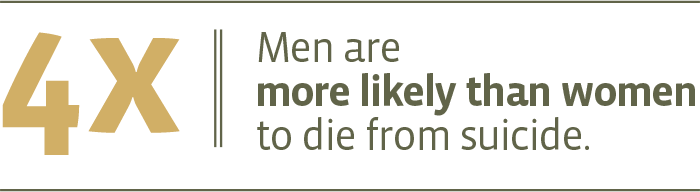
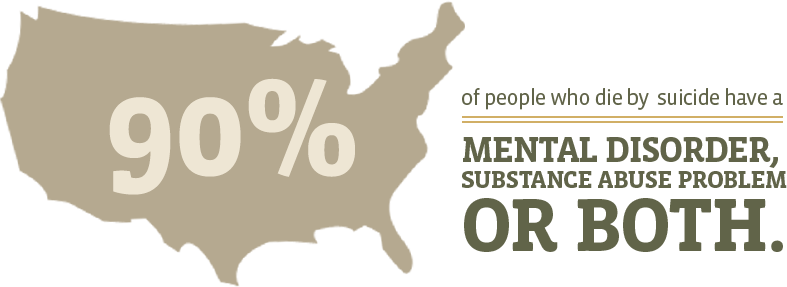
Why is suicide the second, fourth, and fifth leading cause of death among those age groups? What is going on in life that is pushing so many people to kill themselves? According to National Alliance on Mental Illness, “research has found that 46% of people who die by suicide had a known mental health condition.” (2) What is considered a mental health condition? Mental health conditions can consist of Anxiety Disorders, Attention Deficit Hyperactivity Disorder (ADHD), Bipolar Disorder, Borderline Personality Disorder, Depression, Dissociative Disorders, eating disorders, obsessive-compulsive disorder, post-traumatic stress disorder (PTSD), Psychosis, and Schizoaffective disorder. A stressful job or home life along with traumatic life events can also lead people to be more susceptible to having a mental health condition. “Genetics, environment, and lifestyle influence whether someone develops a mental health condition.” (2) Some of the events in life and the health conditions that we face might be hard to change or address at times. The first step is to acknowledge what is going on in your life and what you can and cannot change. Focus directly on what you can control. It might not happen overnight, but by starting today, you will be in a much better place a week from now, a month from now, and a year from now. Imagine all the growth and changes that can happen in one year. I can personally tell you that dedicating one year of self-love, growth, and working on yourself will absolutely change your life. You need to be committed to yourself and a better life. Start today and let’s talk in a year! Prove me right! We can’t take back yesterday but can prepare for and change tomorrow.
“The most common underlying disorder is depression, 30% to 70% of suicide victims suffer from major depression, or bipolar (manic-depressive) disorder.” (3) Symptoms of suicide include feeling sad or having a depressed mood, loss of interest or pleasure in activities once enjoyed, changes in appetite, weight loss or gain unrelated to dieting, trouble sleeping or sleeping too much, loss of energy or increased fatigue, increase in purposeless physical activity, feeling worthless or guilty, difficulty thinking, concentrating, or making decisions, thoughts of death or suicide. Several factors can also play a role in depression, they include biochemistry, genetics, personality, and environmental factors.
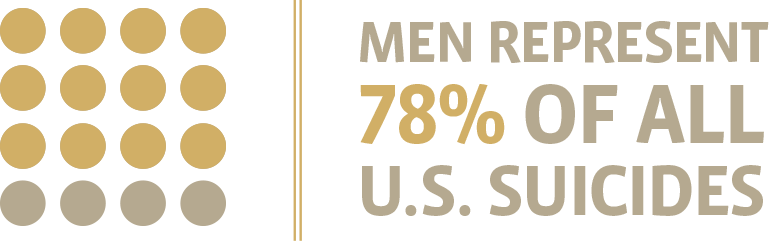
Men may also have a more difficult time seeking therapy, and part of that reason is because of our society’s view on “masculine role” and “social norms” for a male. “Some mental health professionals believe certain social and cultural norms, as well as rigid beliefs about masculinity, may prevent men from seeking help.” (4)
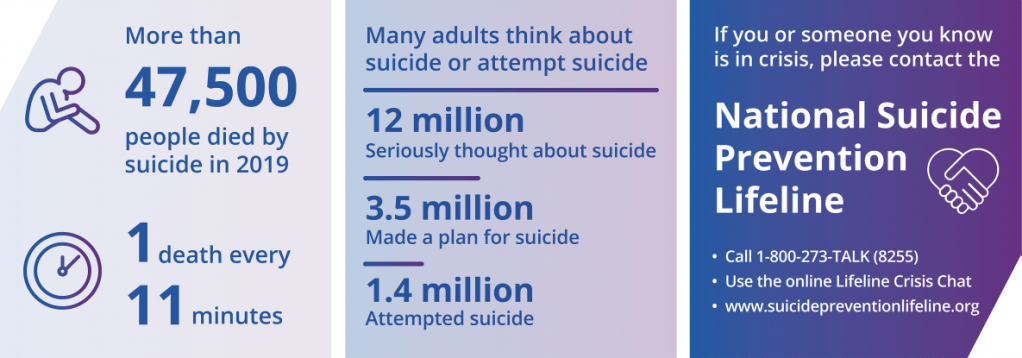
I believe a large factor why suicidal rates are so high amongst men is because of the views we have as a society on seeking help. Talking to a therapist, seeking help, and sharing thoughts and feelings are seen as real signs of weakness. For the record seeking help and trying to better yourself in any capacity is not a weakness, it’s a strength! As a society, we need to be more open, understanding, and supportive of therapy. I believe we would start to see a decline in suicides if people felt more secure in seeking help and opening up. In 2019 suicide was responsible for more than 47,500 deaths, which is about 130 per day and one death every 11 minutes. “In 2019, 12 million American adults seriously thought about suicide, 3.5 million planned a suicide attempt, and 1.4 million attempted suicides.” (1) Some of the warning signs for suicide include increased alcohol and drug use, aggressive behavior, withdrawal from friends, family, and community, dramatic mood swings, and impulsive or reckless behavior. “Men are far more likely to abuse alcohol, binge drink, and to die by overdosing on prescription opioids.” (4) “More than 1 in 3 people who die from suicide are under the influence of alcohol at the time of death.” (5)
Additionally, because men are often conditioned by social norms to refrain from showing certain emotions, such as emotional vulnerability, fear, sensitivity, or dependence, they may fear that expressing these emotions will lead them to be perceived as less masculine. Instead of addressing these issues we (men) turn to alcohol to drown our sorrows and issues. This toxic cycle just continues, and nothing gets better. By “keeping back these emotions may cause other emotional difficulties, and those who attempt to hold back their feelings may find their health and well-being are negatively affected by the practice.” (7) The masculine role and belief that seeking help or showing any sign of weakness is even greater in the military. Talk about shoving all emotions and feelings to the deepest parts of your soul and never, ever bringing them back up again. Do you really think by not addressing them they just disappear, and life goes on all rainbows and sunflowers? Let me burst your bubble, it doesn’t. They eventually come to the surface and typically in some sort of outburst.
As a Veteran, I can directly relate to what most Veterans are going through or have gone through. It’s a great honor to serve one’s country, to fight for your loved ones, and for the freedoms, we are so blessed to have. Serving in the military can also come with additional challenges off the battlefield. “Veterans have an adjusted suicide rate that is 52.3% greater than the non-veteran US adult population. People who have previously served in the military account for about 13.7% of suicides among adults in the United States.” (2) These challenges are not going away just like our enemy on the battlefield. We must seek new tactics to combat these life issues. It’s a new part of life and a new challenge we must face. Burying them, ignoring them, or drinking them away doesn’t help or solve anything. They will still be there in the morning.
According to Veterans Affairs, Veterans with “post-traumatic stress may also lead to anger, as well as aggression, and men with PTSD may be somewhat more likely to cope with symptoms by using drugs and alcohol.” (7)
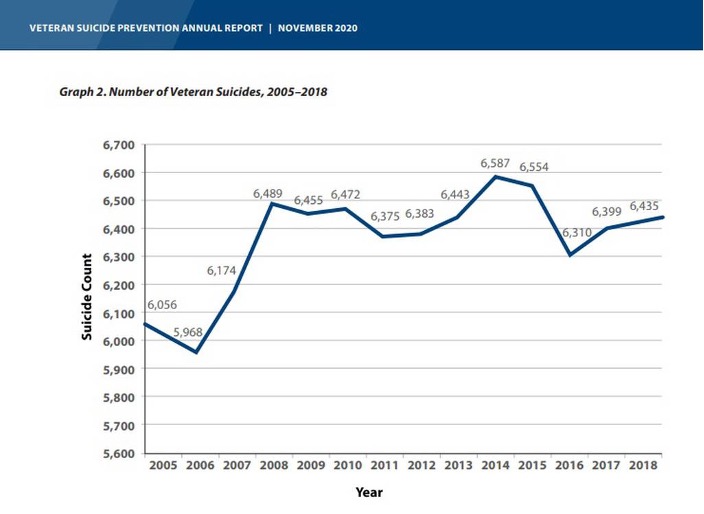
It’s clear that men, veterans, alcohol, and suicide are all wrapped up together in a toxic tornado. Men turn to alcohol to bury or help with their issues which makes them more depressed and anxious, further spiraling them into a bottomless pit. Eventually no longer seeing any hope they turn to suicide to end all the pain. Society must shut its pie hole up about men and their need or desire for help. It absolutely infuriates me that humans can’t ask for help and must kill themselves instead. Life is literally the most precious gift we have on this earth. There is a better way. If you are not supportive, encouraging, or helpful, go pound sand. No one needs to hear your negativity or unsupportive weak-ass mindset.
If you have been through traumatic events, horrible accidents, or experienced life-changing situations it’s more than likely the idea of suicide might come into your thoughts. Life takes us down many paths and experiences, and our brains can work on overdrive thinking about anything and everything. See “Hammy” in my mindset article. It’s not realistic to “never” have such thoughts. It does become a concern when we want to act on those thoughts or start to formulate a plan to carry out suicide. That is when we need to ask for help and really look inside and address what is going on. Please remember that suicidal thoughts are a symptom, and they can be treated and improved over time. You are not alone and don’t have to feel ashamed or embarrassed about it. Brighter days are coming, keep your head up, and mind your thoughts, and we can get through this season of life.
Fish’s seven-step plan for a happier, healthier mental lifestyle. Try it for seven weeks and email me!
- God
- Therapy
- Gym/workout/outside
- Cut alcohol out (or to a very, very minimum)
- 7+ hours sleep
- .5 – 1 gallon of water per day
- Do something that makes you happy (not drugs)

Warning signs that someone may be at immediate risk for attempting suicide include:
- Talking about wanting to die or wanting to kill themselves
- Talking about feeling empty or hopeless or having no reason to live
- Talking about feeling trapped or feeling that there are no solutions
- Feeling unbearable emotional or physical pain
- Talking about being a burden to others
- Withdrawing from family and friends
- Giving away important possessions
- Saying goodbye to friends and family
- Putting affairs in order, such as making a will
- Taking great risks that could lead to death, such as driving extremely fast
- Talking or thinking about death often
If you or someone you know is in an emergency, call The National Suicide Prevention at 800-273-TALK (8255) or call 911 immediately.
Notes
- Centers for Disease Control and Prevention. (2021, August 30). Facts about suicide. Centers for Disease Control and Prevention. Retrieved January 13, 2022, from https://www.cdc.gov/suicide/facts/index.html
- Centers for Disease Control and Prevention. (2021, October 14). Disparities in suicide. Centers for Disease Control and Prevention. Retrieved January 13, 2022, from https://www.cdc.gov/suicide/facts/disparities-in-suicide.html
- Higuera, V. (2021, November 1). Everything you want to know about depression. Healthline. Retrieved January 13, 2022, from https://www.healthline.com/health/depression#causes
- Mental health conditions. NAMI. (n.d.). Retrieved January 13, 2022, from https://www.nami.org/About-Mental-Illness/Mental-Health-Conditions
- Risk of suicide. NAMI. (n.d.). Retrieved January 13, 2022, from https://www.nami.org/About-Mental-Illness/Common-with-Mental-Illness/Risk-of-Suicide
- Suicide. Mental Health America. (n.d.). Retrieved January 13, 2022, from https://www.mhanational.org/conditions/suicide
- Team, G. T. E. (n.d.). Men. Therapy for. Retrieved January 14, 2022, from https://www.goodtherapy.org/learn-about-therapy/issues/men-issues

